
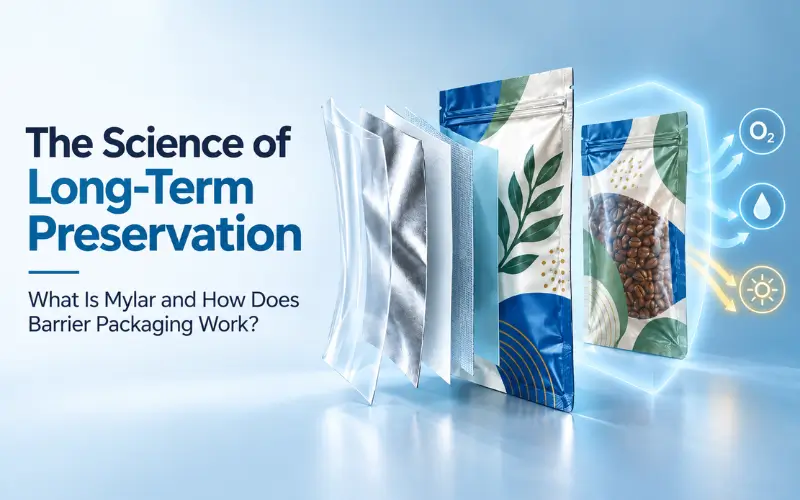
When it comes to protecting sensitive products, the packaging material plays an important role. It can make the difference between years of stable storage and premature spoilage. Among the many materials used in protective packaging, Mylar stands out as one of the most trusted names in long-term preservation. Custom printed Mylar bags combine these protective properties with branded graphics, making them suitable for businesses that need both product protection and brand visibility. But what exactly is Mylar, and why has it become the go-to choice for brands? Let’s break down the science behind it.
What Is Mylar?
Mylar is a brand name for biaxially oriented polyethylene terephthalate, or BoPET, a polyester film stretched in two directions during manufacturing. This process aligns polymer chains, boosting tensile strength, thermal stability, and puncture resistance. Often layered with polyethylene, foil, or nylon, Mylar becomes a customizable, mechanically tough foundation built for demanding protective packaging applications.
Essential Barrier Properties: Light, Oxygen, and Moisture Defense
The true benefit of Mylar packaging is what it protects against, as well as what it retains within. There are three environmental elements that are directly responsible for almost all product deterioration: light, oxygen, and moisture.
Light Protection
Most of the Mylar bags feature the metallized coating on their surface and therefore have a silver look. The reason why this coating is used is that it prevents ultraviolet and visible light from reaching inside the packaging material. This helps prevent the deterioration of chemicals and fading of colors.
Oxygen Barrier
Oxidation is one of the most common ways in which foodstuffs get spoiled. The very tight arrangement of the molecular structure of Mylar results in the creation of an excellent oxygen barrier, thus greatly reducing the time it takes for oxygen molecules to pass through the material. This is highly important in the case of products kept for long periods because even minimal oxygen exposure will cause oxidation.
Moisture resistance
Humidity also constitutes another silent killer for shelf-stable products. A low moisture vapor transmission rate ensures that water vapor does not easily penetrate into the material, hence ensuring that the internal environment remains dry. This has been one of the reasons why Mylar bags have become the standard for long-term food storage and moisture-sensitive electronic or paperwork products.
Together, these three barrier properties are why Mylar is often rated for multi-year, sometimes decades-long, preservation when paired with proper sealing and storage conditions.
The Mechanics of Thermal Sealing: Creating an Airtight Environment
A barrier film alone cannot ensure that the preservation will be successful. The seal is just as crucial a factor in this process because that is when a protective substance becomes an airtight substance. No matter how effective the Mylar bag may be, it could not achieve its purpose without a proper seal being applied, which is why manufacturers give special attention to sealing every bag they produce. This section describes thermal sealing in detail.
How Heat Sealing Works
Mylar bags are usually sealed by means of heat sealing, which is a technique that involves the application of heat and pressure on the edges of the film, thus melting the polyethylene film sufficiently to seal it into one barrier film.
Why Seal Precision Matters
The process of thermal sealing is very important because a minute leakage in the sealing would mean that the whole package will be jeopardized due to penetration of moisture and oxygen. There are different types of sealers, such as impulse sealers and band sealers, which are used depending on the requirements of the packaging material.
Boosting Shelf Life with Absorbers and Desiccants
In addition to the use of heat sealers for items that need maximum shelf life, a number of companies go ahead and put oxygen absorbers or desiccants inside the sealed bag. The oxygen absorbers will absorb any leftover oxygen inside the sealed bag to increase shelf life even more. When used in combination with heat sealing, it will create an airtight environment for the contents.
Mylar Bags vs. Vacuum Sealing: Which Preserves Better?
In choosing a preservation technique, two different techniques can be compared to one another; namely, the Mylar bag technique and vacuum-sealing technique. While both of these techniques involve the removal of oxygen from the vicinity of the product, their methods in doing so vary, along with the duration of their effectiveness.
| Factor | Mylar Bags | Vacuum Sealing |
| Barrier Protection | Blocks light, oxygen, and moisture via a metallized layer | Blocks oxygen and moisture, but standard bags don’t block light |
| Shelf Life | Up to 20 to 30 years for dry goods with oxygen absorbers | Typically 1 to 5 years, shorter for most food types |
| Best For | Long-term storage of grains, rice, beans, freeze-dried food | Short to medium-term storage, meats, cheese, refrigerated or frozen items |
| Puncture Resistance | High, especially at higher mil thickness | Lower, more prone to tears and pinholes |
| Equipment Needed | Heat sealer or impulse sealer | Dedicated vacuum sealing machine |
| Oxygen Removal Method | Oxygen absorbers placed inside before sealing | Mechanical suction removes air directly |
| Reusability | Resealable options available with zip locks | Bags generally not reusable once cut open |
| Ideal Use Case | Emergency food storage, bulk preservation, retail packaging | Everyday food prep, meal planning, freezer storage |
Commercial Applications & Reusability in Modern Packaging
Many modern Mylar bags are designed with resealable zip-lock closures, allowing consumers to reopen and reseal the package multiple times without significantly compromising the barrier properties. This makes Mylar packaging not just protective, but practical for everyday use. A major reason it has moved beyond industrial storage is that Mylar bags have become a popular choice for brands looking to combine durability with shelf appeal.
- Food and beverage: Coffee, spices, dehydrated meals, snacks, and freeze-dried products all benefit from Mylar’s extended shelf-life properties.
- Pharmaceuticals and supplements: Light- and moisture-sensitive capsules, powders, and tablets rely on Mylar’s protective barrier to maintain potency.
- Cannabis and CBD products: The industry has widely adopted Mylar bags for both compliance-driven child-resistant packaging and brand presentation.
- Electronics: Anti-static Mylar variants protect sensitive components from humidity and electrostatic discharge during shipping and storage.
- Retail and branding: Businesses increasingly use custom-printed Mylar pouches with resealable zippers, offering both functional protection and eye-catching shelf appeal.
Conclusion
The success of Mylar in transitioning from an industrial film to one that is a staple in the packaging industry can be attributed to straightforward science. Mylar packaging works to create an atmosphere that preserves a product when used together with the right thermal sealing techniques for months, and sometimes years. Selecting packaging that provides the same quality protection and manufacturing and design capabilities is equally as important as the science involved. Choosing a well-known provider like Expert Custom Boxes will guarantee your products receive it all.
Read Also: Microwave Corn on The Cob