
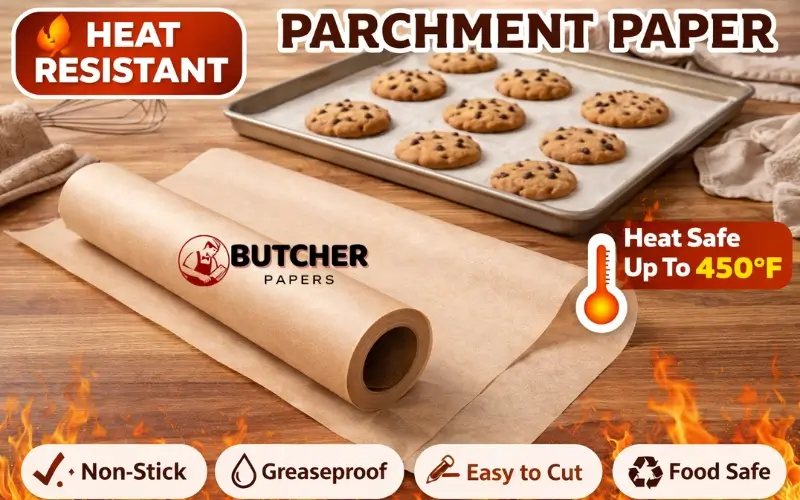
The resistance of parchment paper to heat is an important issue that every individual engaged in baking, roasting or food manufacturing would need to understand how it works. Knowing the temperature limits, safety standards, and differences in performance whether you operate a commercial kitchen or you bake at home may avoid expensive errors and enhance the quality of food.
Parchment Paper Temperature ratings, safe use, usage comparisons with other materials, and the correct methods of choosing professional grade parchment to achieve the same results.
What Is Parchment Paper and Why Is It Heat Resistant?
The parchment paper is a specially-treated paper that is made of cellulose and coated with silicon. This silicone coating makes it be able to stick to nothing and also makes it able to endure the high temperatures in the oven without burning easily.
This silicone coating is the reason why parchment paper heat resistant performance is reliable. It forms a layer that slows down the combustion and shields the paper fibers against direct heat. Nonetheless, one should realize that parchment is not flameproof, but is heat resistant.
Parchment paper is stable even under recommended oven conditions when made to the standards of food grade, and it does not emit harmful substances.
Maximum Temperature Limits You Should Know
The standard parchment paper is known to be safe up to 420 o C or 425 o C. High-quality commercial grade ones can comfortably withstand 450F (232 C).
Exceeding these temperatures may cause:
- Darkening or browning
- Curling edges
- Increased brittleness
Eventual ignition if exposed to direct flame
Ignition may occur eventually when it comes into direct flame.
The most important thing is safe usage and that is not exceeding the labels. Most professional kitchens usually confirm the temperature rating of the suppliers they buy in bulk like butcherpapers.com to ensure that there is consistency in performance.
What Happens If You Exceed the Heat Limit?
When parchment paper is subjected to high temperatures, it will not immediately end up catching fire, as long as the maximum tolerance of the paper is not exceeded. It instead turns dry and fragile as it gradually becomes brown. The issues arise in cases where the paper comes in contact with a heating component or an open flame.
That is why it is not advisable to have broiler settings. In the typical baking practices, parchment paper heat resistant qualities are safe when instructions are adhered to.
Baking businesses that need consistency tend to get consistent-grade products at butcherpapers.com to prevent fluctuation of their products based on temperature.
Parchment Paper vs Other Baking Materials
To understand the importance of heat resistance, it helps to compare parchment paper with alternatives.
| Material | Maximum Safe Temperature | Oven Safe | Non-Stick | Best Use |
| Parchment Paper | 425–450°F | Yes | Yes | Baking, roasting |
| Wax Paper | Around 200°F | No | Yes | Wrapping only |
| Aluminum Foil | 500°F+ | Yes | No | High-heat roasting |
| Silicone Mat | 480–500°F | Yes | Yes | Repeated baking |
The result of the use of the wax paper in the oven is a number of accidents that happen during the process in most kitchen accidents. Compared to parchment paper that has a heat resistant design, the wax paper has a layer of wax that melts and burns when exposed to heat.
Bleached vs Unbleached Parchment Paper
An important difference does not exist in heat tolerance of bleached versus unbleached parchment paper. There is a similarity in the temperature ratings of the two.
| Feature | Bleached | Unbleached |
| Appearance | White | Brown |
| Heat Resistance | Same | Same |
| Food Safety | Food-grade | Food-grade |
| Performance | Equal | Equal |
The choice usually depends on branding preference or environmental considerations rather than temperature capability.
Is Parchment Paper Safe for Commercial Kitchens?
Yes, provided it meets food grade standards of production. The quality parchment paper is expected to be free of odor, non-greasy and resistant to heat.
Food businesses can hardly do without reliability. Non-even thickness or low quality of coating may affect the operation of the parchment paper in high-volume baking settings in relation to the degree of heat resistance.
This is why restaurants and bakeries usually sample products once they are assured that it is of good quality that they will be able to stick with the suppliers of butcherpapers.com in the long term.
Common Applications in Professional and Home Kitchens
Parchment paper is an important item in baking and food preparation. It helps eliminate sticking, promotes even-browning, and makes it easier to clean.
It is generally applied in the lining of baking trays, making delicate pastries, roasting vegetables and wrapping fish where it is required to be cooked in a moist condition. Due to its reliable heat resistant parchment papers, it allows consistent cooking outcomes without physical touch.
Parchment is also safe in air fryers, although the temperature should not be allowed to get too high and the airflow should not be impeded.
Can Parchment Paper Catch Fire?
Any paper product can ignite under extreme conditions. However, when used correctly within its temperature range, parchment paper rarely catches fire inside an oven.
Problems usually occur when:
- Paper touches heating elements
- Excess paper hangs too far over tray edges
- Broiler settings are used
Knowing where to place it and how to control temperatures is beneficial so that heat resistant performance of parchment paper does not become dangerous and unpredictable.
To eliminate or minimize any risks linked to safety, professional kitchens tend to create rigorous guidelines of using ovens and procure reliable stock through the butcherpapers.com.
Does Parchment Paper Affect Food Flavor?
Parchment paper of good quality is tasteless and odorless. It is odor free and neutral.
The low-grade substitutes can easily discolour or even give a faint odour under high temperatures and this can influence the fragile baked products. This is the reason why the business purchasers consider suppliers such as butcherpapers.com very keenly before ramping purchases.
Environmental Considerations
Recent materials of parchment paper are compostable and sustainably sourced. Although it can be disposed of it is not wasteful because some brands adopt sustainable forestry practices and chlorine-free processing.
Sustainability is also dependent on heat resistance. Where the quality of the parchment paper that is resistant to heat is good, then fewer sheets are lost before being burned or torn.
Reusability and Practical Limits
Parchment paper may be reused occasionally provided that it is still structurally sound and is not very dirty. It can be, however, when it grows dark, brittle, or too greasy, then it ought to be disposed of.
In the case of businesses, reusability has to be carried out against the hygiene norms and food safety compliance.
Why Heat Resistance Matters for Food Businesses
Consistency is a profitability motivator in the business environment. Having slight differences in the baking surfaces can affect the patterns of browning and the quality of the product.
Reliable parchment paper heat resistant capacity ensures:
- Stable baking performance
- Reduced sticking and product damage
- Faster cleaning processes
- Professional presentation
Food producers and bakeries that rely on buying in large quantities usually research long term suppliers like butcherpapers.com to keep quality control standards.
Choosing the Right Parchment Paper
When choosing parchment paper to use in high temperatures, look at the thickness, quality of silicone coating and tested temperature ratings. Sheets that have already been cut are usually more efficient in professional kitchens than rolls.
Companies who are interested in expanding their operations can rely on reliable parchment sourcing by butcherpapers.com to make managing inventory easier and to guarantee product conformity.
Final Thoughts
The knowledge of the heat resistance property of parchment paper makes homes and commercial kitchens bake securely and efficiently. Adhered to the suggested temperature, parchment paper is dependable, non-sticking, and is useful in numerous bakery and roasting products.
The correct grade selection, absence of extreme temperatures, and correct placement methods will provide the same results in cooking and minimize the risk in food preparation (small and large-scale).
Frequently Asked Questions
At what temperature is parchment paper resistant to heat?
The majority of parchment paper is safe at 425 0 -450 0 F depending on the manufacturers.
Is it possible to use parchment paper at 500o C?
It is not recommended. Long exposure of more than 450 o F can lead to burning or brittle.
Is the parchment paper safe to use in the oven as compared to the wax paper?
Yes. Wax paper cannot be used in the oven whereas parchment paper is made of baking temperature.
Why does parchment paper get brown?
Browning is seen when it reaches optimum temperature limit. Browning is normal, and it is light.
Is it possible to reuse parchment paper?
It could be reused when it is clean and in good structural condition, but when it became brittle or soiled, the reuse was no longer possible.